Are You Travelling Soon? ✈️
Your answer opens a sponsored ad before the guide.
Airline Travel Rules In 2026 You Need To Know About
Flying in 2026? A bag that fitted on your last flight, a power bank packed in the wrong suitcase or even the wrong assumption at airport security could catch you out. Airline and airport rules are not the same everywhere, and requirements can vary by carrier, ticket, airport and country. Before your next flight, check these four areas: cabin baggage, checked luggage, what you wear through security and the screening rules at every airport on your journey.
What Do You Want To Check First?
Your selection opens a sponsored ad before the guide.
New Airline Rules For Carry-On Bags
Your old cabin bag is not automatically suitable for your next flight.
There is no single worldwide carry-on size or weight allowance. Airlines set their own baggage policies, and the allowance can also depend on the fare you purchased.
A small personal item designed to fit underneath the seat and a larger cabin bag for the overhead locker may have completely different limits. Some fares include both, while others include only a personal item unless you pay for additional cabin baggage.
Check your actual booking
Don't rely on the words “cabin size” printed on a suitcase.
Instead, check:
- Maximum bag dimensions
- Maximum weight, if applicable
- Whether wheels and handles count towards the dimensions
- Whether a personal item is included
- Whether an overhead cabin bag is included
- Rules for connecting flights operated by another airline
For example, Ryanair currently includes a small personal bag measuring up to 40 × 30 × 20 cm. Its Priority & 2 Cabin Bags option adds a 10 kg cabin bag measuring up to 55 × 40 × 20 cm.
British Airways currently lists a cabin bag up to 56 × 45 × 25 cm and a smaller personal item up to 40 × 30 × 15 cm on its own flights.
These are examples, not universal standards. A bag accepted by one airline could be too large or heavy for another.
Don't get caught out at the gate
Measure your bag after you've packed it, including protruding wheels, handles and overfilled pockets.
Also prepare for the possibility that an airline may require a cabin bag to be placed in the hold. Keep travel documents, essential medication and valuables somewhere accessible.
Power banks and spare lithium batteries generally require particular attention and should not simply be left inside a bag being gate-checked. Check the rules of your airline and the relevant aviation authority before travelling.
The safest habit in 2026 is simple:
Check the baggage allowance shown on your actual booking before every flight.
Sources checked: Ryanair Bag Policy, British Airways Baggage Essentials and FAA battery guidance. Airline policies can change, so verify your booking before departure.
Items Banned From Checked Luggage
One of the easiest packing mistakes involves an object millions of travellers carry: a power bank.
Putting something in checked luggage does not automatically make it permitted.
Keep spare lithium batteries out of checked baggage
For US air travel, FAA guidance requires spare lithium batteries and power banks to remain in carry-on baggage rather than checked luggage.
Battery terminals should be protected against short circuits, such as contact with keys, coins or other metal objects.
Battery-powered electronic cigarettes and vaping devices are also subject to specific restrictions. FAA guidance requires them to be carried in the aircraft cabin or on the passenger rather than in checked baggage, with precautions taken against accidental activation.
This does not mean they can be used or charged whenever you want during a flight, and destination countries may impose additional restrictions on vaping products.
If airline staff require your cabin bag to be gate-checked, remove spare batteries and power banks before handing it over.
Battery capacity can matter too. Larger lithium batteries may require airline approval or may not be permitted at all.
Some dangerous items cannot simply be moved to the hold
Other restricted items can include:
- Fireworks
- Fuel
- Lighter refills
- Certain flammable products
- Some compressed gases
- Flammable non-toiletry aerosols such as spray paint
Rules for toiletries and medicinal products can be different, so it would be misleading to assume that every aerosol is prohibited.
Devices containing installed batteries can also be treated differently from loose spare batteries. Depending on the applicable rules, some devices may be permitted in checked baggage if completely switched off and protected from accidental activation and damage.
Damaged, defective or recalled batteries can be subject to additional restrictions.
For worldwide travel, check the dangerous-goods guidance applicable to your departure country and your airline's own conditions. Connecting and destination countries may impose additional requirements.
Sources checked: FAA PackSafe and FAA Airline Passengers and Batteries guidance. Requirements differ internationally, so check the aviation authority and airline relevant to your itinerary.
What Not To Wear At An Airport
There isn't a universal worldwide list of clothes you're forbidden from wearing through airport security.
The bigger issue is choosing an outfit that can make screening more complicated than it needs to be.
Be careful with excessive metal
Large amounts of metal in clothing or accessories can potentially result in additional screening.
Canada's CATSA advises travellers to avoid items such as large metal belt buckles and clothing containing metal studs, snaps or buttons where possible when preparing for screening.
Some footwear can contain substantial amounts of metal too, including steel-toe footwear or shoes with internal metal supports.
That doesn't mean every traveller must remove every piece of jewellery or every pair of shoes.
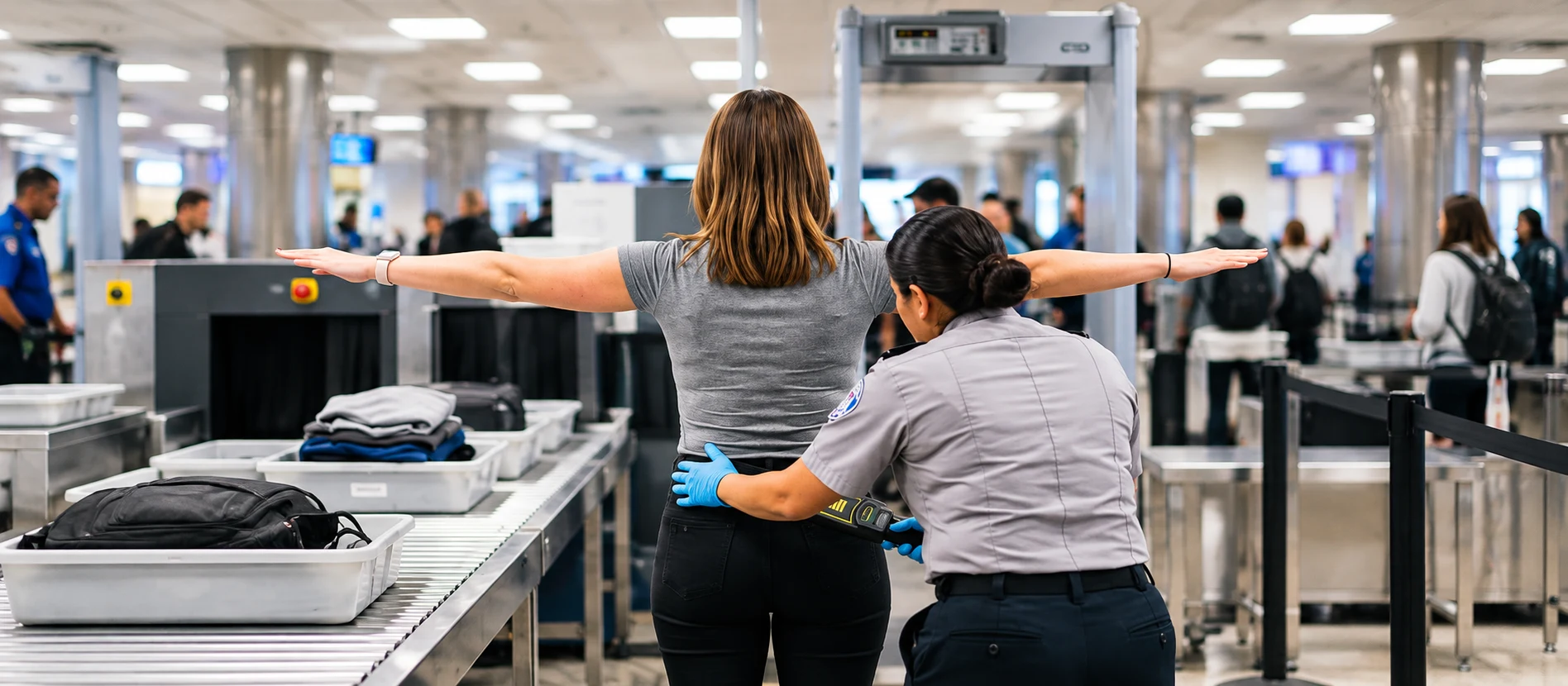
Screening procedures vary by airport, country, equipment and individual circumstances. Follow the instructions given at your checkpoint rather than assuming the procedure will be identical to your previous trip.
Wear something easy to manage
For a smoother journey, consider:
- Comfortable footwear that is easy to manage if removal is requested
- Layers that can be removed easily
- Fewer unnecessary items in your pockets
- Keeping travel documents somewhere accessible
- Avoiding complicated accessories if you don't need them
At Heathrow, for example, passengers may be instructed to place coats or jackets into a tray during security screening.
Requirements elsewhere may be different.
Religious clothing, medical devices, disabilities and other individual needs can involve different screening procedures. Travellers who require assistance or have concerns should check the official guidance for the airports they will use before travelling.
These clothing suggestions do not guarantee faster screening. They simply reduce some avoidable complications.
Sources checked: Canadian Air Transport Security Authority (CATSA) screening guidance and Heathrow Airport security guidance.
Security Check-In Mistakes To Avoid
One surprisingly common mistake happens before you even reach the security trays.
Checking in, dropping a checked bag, passing through security and reaching the boarding gate are separate stages — and completing one doesn't necessarily mean you're safe to ignore the deadline for another.
Don't assume your return airport has the same rules
Airport security procedures can vary considerably.
Liquids are a good example.
GOV.UK advises that rules can vary between UK airports. Many restrictions have historically centred around containers of 100 ml or less, while airports equipped with newer screening technology may permit different limits.
Heathrow currently states that passengers can take liquids in containers of up to 2 litres through security and can leave liquids and large electrical items inside their bags.
That does not mean the same procedure applies at every airport in the UK, let alone worldwide.
Your departure airport, connecting airport and return airport could all operate differently.
Where a 100 ml container limit applies, putting only 50 ml of liquid inside a 200 ml bottle does not necessarily make that container acceptable.
Products treated as liquids can also include things travellers sometimes overlook, such as:
- Toothpaste
- Gels
- Creams
- Pastes
- Liquid cosmetics
Essential medicines, baby supplies and special dietary liquids can have exemptions or separate procedures depending on the jurisdiction.
Prepare before reaching the checkpoint
Before joining the security queue:
- Have your boarding pass and required documents accessible
- Check the current liquids rules for that specific airport
- Follow local instructions regarding laptops and electronics
- Empty pockets when instructed
- Remove jackets or other items when requested
- Make sure electronics have sufficient charge if authorities may require them to be switched on
Most importantly, listen to the security officers at the airport you're actually using.
New scanners don't mean every airport has adopted identical rules.
Don't rely on one universal arrival time
There isn't one arrival time that guarantees you'll make every flight.
Check your airline's:
- Check-in deadline
- Checked-baggage deadline
- Boarding time
- Gate-closing time
Then consider the airport's own advice, security queues, terminal transfers, connections and any assistance you require.
A few minutes spent checking documents, baggage, batteries, liquids and deadlines before leaving home can be much easier than discovering a problem at the airport.
Sources checked: GOV.UK Air Travel Checklist, GOV.UK Hand Luggage Restrictions, Heathrow Airport security guidance, FAA guidance, CATSA guidance and current airline baggage policies.
Information checked for October 2026. Airline, airport and government requirements can change, and rules differ around the world. Always verify the current requirements for your airline, departure airport, connecting airports and destination before travelling.